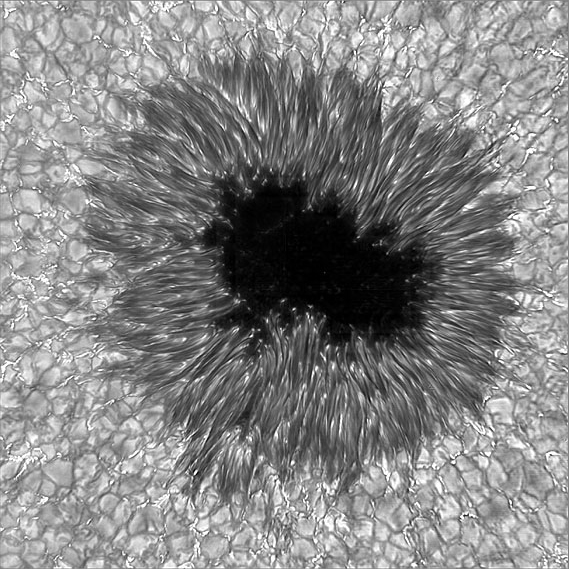
So minutes after I posted the previous thread, I found this even sharper image of a sunspot that is quite amazing. Taken with the National Science Foundation's Dunn Solar Telescope fittingly located in Sunspot, NM.
So minutes after I posted the previous thread, I found this even sharper image of a sunspot that is quite amazing. Taken with the National Science Foundation's Dunn Solar Telescope fittingly located in Sunspot, NM.
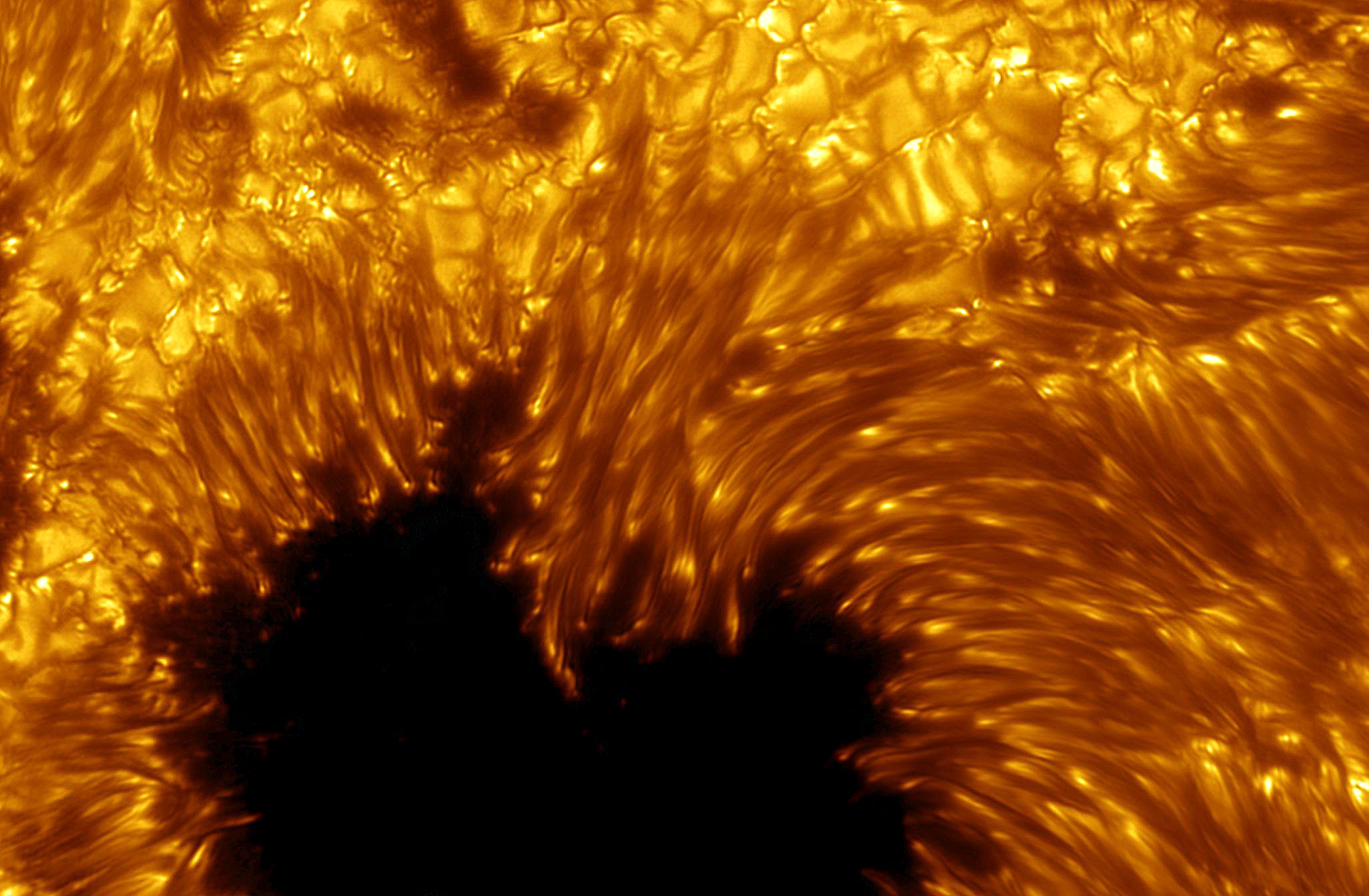 I have to admit this is my first direct lift right from Astronomy Picture of the Day (dating back to November 2002). Some recent images of Solar prominences and arcs are pretty close in quality if not surpass this, but I don’t think I have seen anything comparitively detailed of the actual surface like this. The image was acquired through the ground-based Swedish Solar Telescope located on the Canary Island of La Palma. Despite the ground-based operation, it still was able to make an image of the Sun that surpassed any of those taken by the observatories in orbit at that point in time.
What is seen in the above image is a dark region known as a sunspot which is a planet sized area of unknown origin. 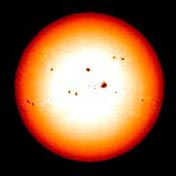 It has a much lower temperature than its surrounding areas and emits a tremendous amount of magnetic activity. Of course, any imaging the Sun in normal visible light with no photographic trickery would result in an entirely white image with no details at all. So the funny thing about these “dark spots” (see visible/white light image at left) is that they are actually blindingly bright to a human eye. It is only when we image these areas in comparitive contrast with the surrounding hotter areas do they appear as dark in photographs. These mysterious spots seem to also appear in abundance in 11 year cycles which also eludes any scientific explanation.
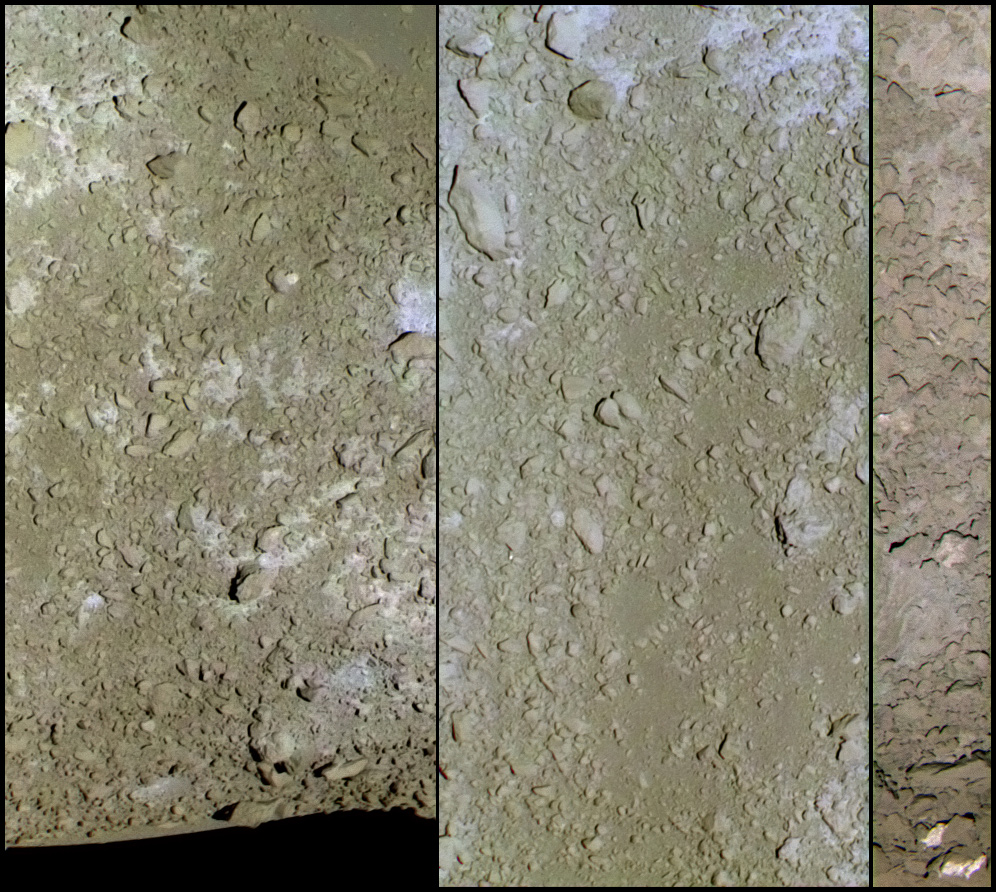 Itokawa (full name 25143 Itokawa) is an Earth crossing type asteroid that was visited by JAXA (Japan Aerospace Exploration Agency) in 2005. It was, and still may be, the first asteroid to be sampled and returned to Earth. To make a long story short, JAXA attempted quite a complicated mission for such a young agency and sent a probe to Itokawa. The plan was for Hayabusa to orbit, land upon, sample a bit of the surface and then return those samples back to Earth for retrieval. Currently, the mission is seriously damaged and operating on 1 of 3 reaction wheels. Additionally, Hayabusa suffered a major solar flare that damaged several battery cells, a rehearsal landing failed, the agency is unsure if any samples actually made it into the return cannister and 2 probes designed to study the surface also failed. Despite all this trouble and serious concern about its ability to even make it back to Earth… in early 2007 Hayabusa began its long questionable trip back home. Should it make it, the sample return cannister should re-enter Earth atmosphere in 2010.
Never surrender!

For full resolution monster sized image click here.
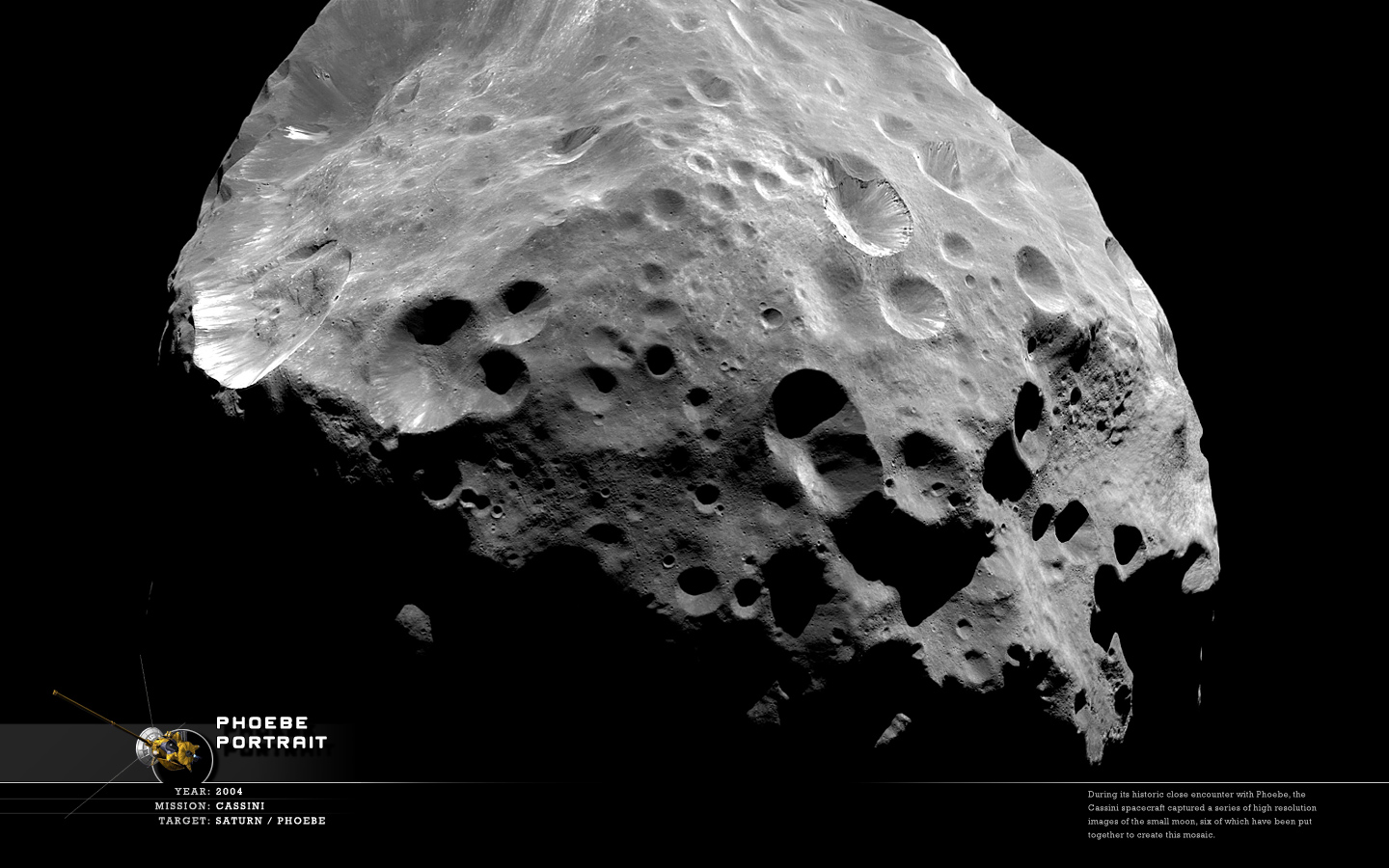 A few posts back I uploaded a closer detail of this same image. This is the best “portrait” image of Phoebe available taken by Cassini on its way into the Saturn system and orbit insertion. Being so far out from the rest of the most dle scientific targets (4x as far as Iapetus), this was the only up-close visit planned to the tiny moon who’s size is about 220km average width.
Two impressive images from the New Horizons mission as it sped past Jupiter last February. Releases sure are taking time… they must be coming back in on e pixel a day!

Best detail yet seen on a volcanic plume on Io
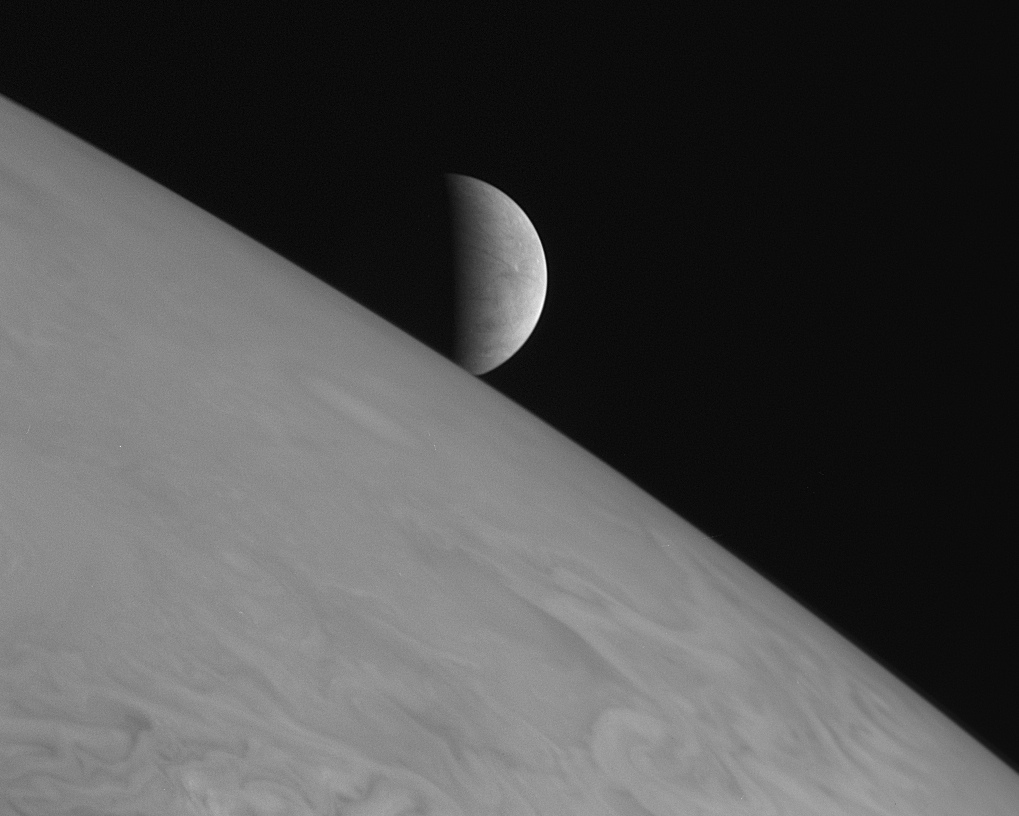
Europa seen rising Apollo style over the edge of Jupiter.
 There appears to be a layer of dark material covering the small moon Phoebe as revealed by the collapse of materials in the northern region of the small moon. Phoebe orbits Saturn outside the orbit of Iapetus and has been considered a possible candidate for the dark material also found covering one side of that unusual moon. What may have caused this transfer of materials is still a mystery… or that Phoebe had anything to do with that feature on Iapetus is still very much in question.
Some propose that Phoebe is actually a captured comet from the Kuiper belt (a region of small bodies orbiting the sun beyond Neptune of which Pluto is considered a member). If this is true, the images taken by cassini would be the only images of such bodies to be anything other than a single point of light.

I noticed some recent images taken of Dione would make a nice hires if one were to stitch them together. Of course, these images were each (4 of them) taken at different times and therefore, the cassini spacecraft was at different vantage points (see the original 4 images below).
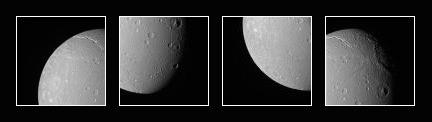
So matching them up is not quite as simple as lining up a few repeat details from one to the next, but photoshop gives one some powers of distortion to make up for some of that. The biggest issue was the disc edges – for when they didn’t match up (and they didn’t) all there was for me to do was to draw a circle and erase. I cannot match the technical skills of some of the freelance imagers that I have featured on the right, but its fun making myself a nice large scale image of one of Saturn’s larger moons.
Soon after the Stardust mission flew in close and collected tiny samples of comet dust in Jan 2004 from the comet Wild 2, the spacecraft was placed into hibernation mode – only to be awakened for occasional health status calls.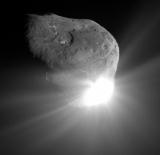 A proposal to extend the mission into Stardust-NExT suggests the spacecraft be sent on a trajectory to encounter comet Tempel 1. The main objective of this mission would be to image the crater left behind by the Deep Impact mission of 2005. That mission did not manage to image the resulting crater due to the huge amount of dust blasted off from the impact (pictured above-left) which blocked the view until well after DI’s cameras were out of range to see any details on its surface. The final decision on this extended mission is expected this May/June and should it be approved… it is expected that Stardust-NExT would reach Tempel 1 at some point around 2010.

NASA has put out a “Return to the Moon” trailer at anon.nasa-global.edgesuite.net
 According to the Cassini website, this image was taken at about 58 degrees below the ring-plane in the southern hemisphere. The southern lower half of Saturn tends to appear yellow-peach while (at current) the northern half of Saturn leans to a white-grey-blue, with varying effects from the shadows of the rings cast upon the cloud tops (just visible on the middle-left). It is unusual to view such a large area of Saturn’s globe without the intrusion of rings or ring-shadows and it reminds us how gorgeous Saturn would be even without its stunning rings.
 Two views of Ganymede’s patchwork surface taken by Galileo around 1997. While some areas appear geologically older (as demonstrated by the record of impact cratering) some seemingly younger areas recall the fracturous features seen at Europa. Many theorize, just as they do at Europa, that there may be a global ocean of water beneath the surface at Ganymede. However, it is also assumed (if if this does exist) that this ocean would be more shallow and under a much thicker crust of rock hard ice than that of Europa.
 Visual evidence that Enceladus hosts cryo-geysers around its southern pole. The lighter surrounding area is due to Saturn’s E-ring, whose materials are supplied by these same geysers.
This is another image supplied by Mr. Gordan Ugarkovic who notes that “this is a colorized image, artificial color was added to make the plumes and E ring subtly bluish, while saturnlit portion of Enceladus slightly brownish. In reality no color frames were taken, only clear filter ones”.
My full time company (unrelated to space interests) has launched its “shop” and is sporting a bunch of tees and designs aimed at computer nerds, designers, illustrators and nerds in general. While I don’t have any directly space related designs up there (yet), there is a poster we did for an event I spoke at does feature me as a robot surrounded by a few moons. You may even recognize one as slightly Mimas looking and the other a bit Europan. The other two are just your generic cratered looking ice balls.
 Ariel is the third of the five larger moons or Uranus. It is somewhat similar to Saturn’s Rhea in composition, about 30% rock and 70% ices. There are obvious ridges and details that would appear to be somewhat “young” features (which is still quite old to you and me), but there is little known about this moon as it was only viewed once from 127,000 km by Voyager 2.
 An almost Apollo class image of the cliffs of Dione rising at its horizon. Many of the cliffs pictured here are from impact craters, but Dione is also well known for its “wispy” details which have been revealed by Cassini as fractures which result in giant ice cliffs and valleys. You can see one crater actually cross-sectioned by one of these fractures at the extreme far right side of the wallpaper image above.
The origins of these fractures are yet unknown and it is generally accepted that these are relatively recent formations as many of them run through impact craters which are known all over the solar system to be ancient details. As a matter of fact, impact cratering is how most planetary scientists are able to rate the age of a surface by the absence or presence of crater events. Bodies with many craters (our moon, Callisto and Mercury) are considered to be old and generally unchanged since early in its formation history as it is assumed that the period of heavy cratering happened soon after the formation of the solar system. Bodies with less cratering (like Earth, Io and Titan) are considered to have “young” surfaces which have been geologically changed over the ages and erased the record of impact cratering.
 From the Cassini website, “Like black and white photos of earthly family and friends, monochrome images of Saturn can also capture their subject with crisp poignancy. This infrared view from high above Saturn's ringplane highlights the contrast in the cloud bands, the dimly glowing rings and their shadows on the gas giant planet. The overall effect is stirring”.
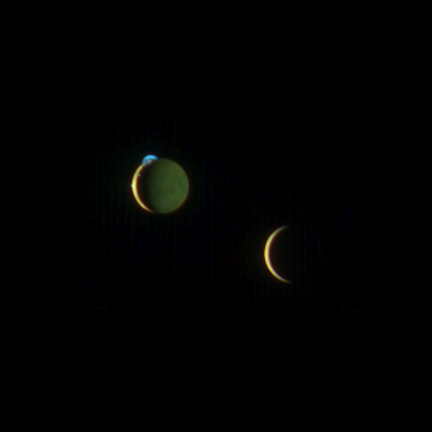
New Horizons has some sensitive vision for its investigation of the Pluto system. Because there is so little light at Pluto (comparitively), when looking back at Io and Europa it was able to capture this image with what looks like a considerable amount of “jupitershine” reflecting off of Io. Normally this kind of reflection is quite subtle. Furthermore, the reason Europa has no “jupitershine” is because it is closer to New Horizons on the dark side of Jupiter and Io is further away on the sunlit side of Jupiter… therefore capturing some light bouncing off the cloud tops.
Yes, the blue thing on Io is a volcano.
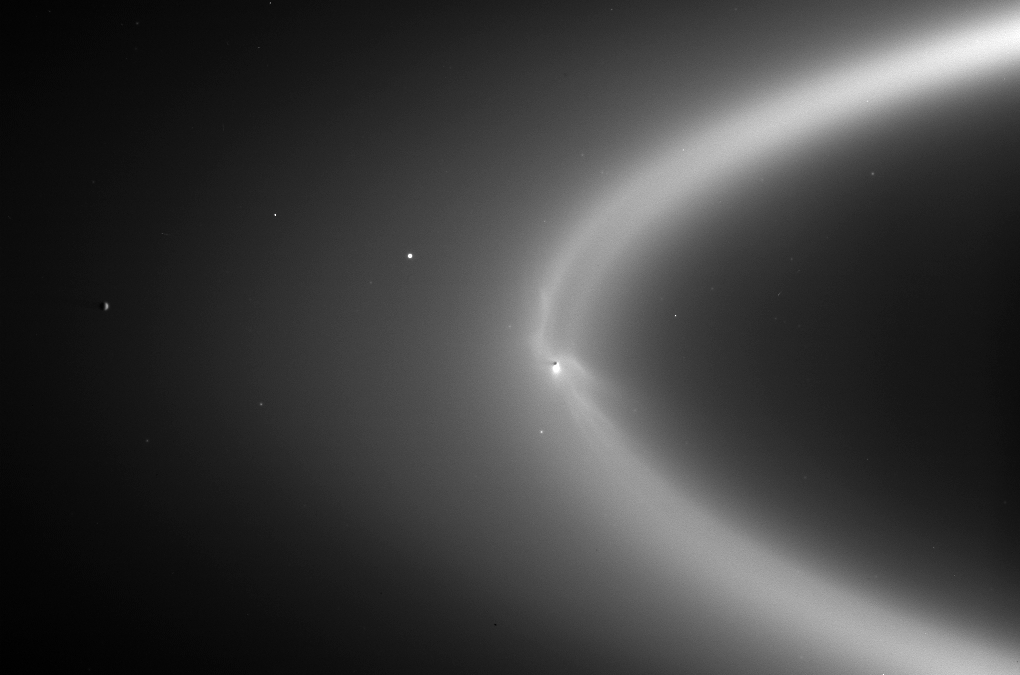
Hopefully by now, most people are aware of the shocking activity at this small moon named Enceladus at Saturn. It appears the moon is continually spewing out material (likely water-ice and rock) from a number of geysers located around its southern pole (see Life in the Hood: Enceladus for reference).
This image was taken around September of 2006, and reveals how Enceladus is actually constructing another ring around Saturn. The “ring” is not normally very visible, but by taking the image with the sun almost directly behind the structure - the particles become back-lit and appear brighter, like dust in a ray of light.
Close inspection of the image reveals quite a bit going on in there. You can see a darker path behind Enceladus as it sweeps up materials already left in it’s path from previous orbits. While in front and around the small moon, you can see jets of material being generated and going into orbit around Saturn. A similar phenomenon is happening at Jupiter with the torus created by Io’s volcanos as well, but I am unaware of any images illustrating that phenomenon as detailed as the one seen here.
 For my money, nobody does Saturn better than Gordan Ugarkovic. PLEASE browse his Flickr account when possible. The bigger spot is Dione and the two tiny pin-pricks are Janus and Epimetheus.
