 Rhea on the edge.
Anyone Looking for Cialis or a Mortgage
I have been getting tons of comments lately about Cialis and Mortgages and deleting them as they come in. If anyone on here is looking for that I can forward them on to you. I know how common it is for people surfing space related subject are often also seeking deals on cialis, mortgages and especially diapers.
Lots of Water on Mars

The top image shows the radar imaging of underground structures on Mars, below that is the typography of that same region and the radar swath is represented by the white line that cuts through it.
In the radar image, the point at which the traces or “layers” split into two (on the left side) is where it is thought that the materials change and so the radar is echoing again off that lower subsurface. They also add that “the strength of the lower echo suggests that the intervening material is nearly pure water ice”, which apparently may translate into a depth of 3.5 kilometres of ice. This image is not alone, additional radar scans have suggested ice that runs to a depth of 1.5km in other places with surely many more to come.
It would seem that the intended purpose of finding where, or if, water exists on Mars has more or less been satisfied. I don’t think that anyone expected to find this much evidence of water on Mars between the recently discovered water flows and now a nearly planetwide (theoretical) underground reservior of pure water ice. Future astronauts on Mars will not go thirsty!
Graphic Saturn Interpretive Colors
So maybe I’m just going to go with a more fantastic version of Saturn color. I also opted for the more familiar “front lit” view of the rings.

A Graphic Rendering of Saturn
I have two really… the more detailed one is a bit photographic and i’m wondering if that is “better”? I mean, we already have photos so what’s the point? I am trying to make a nicely designed poster so should I go with the simpler (and therefore) more graphic version???
Less details:
More details:

At this size you really barely see the details. Click on for larger version of each.
By the way, the rings look really different because they are supposed to look back lit in this illustration.
I Drew the Cassini Spacecraft
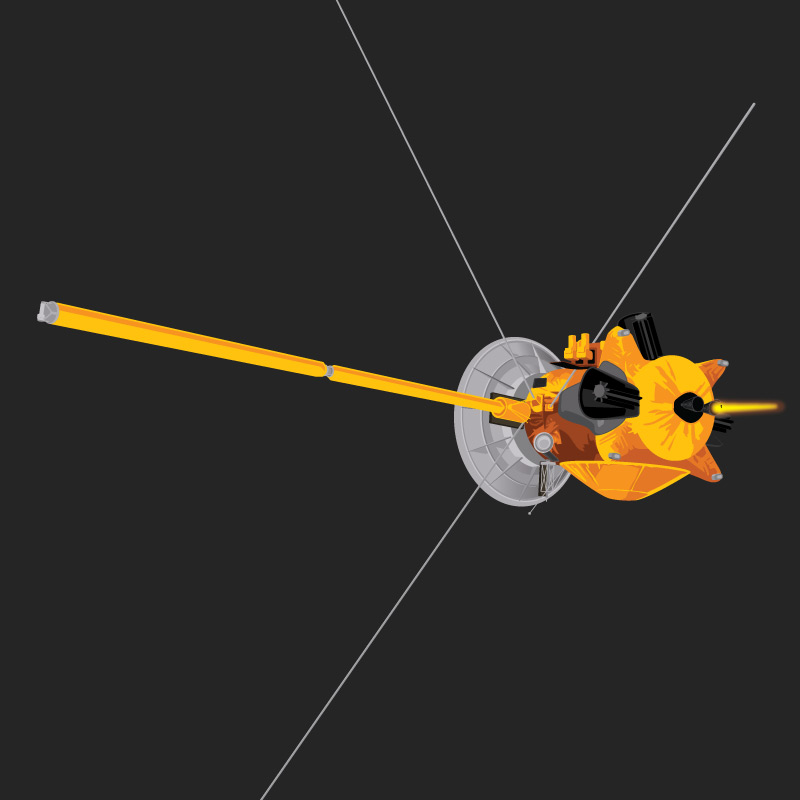
So, I am tentatively planning to make a poster for the Cassini mission at Saturn. I always wanted to get a real nice graphic poster of some mission to Mars, Jupiter or Saturn… but the posters out there are always data driven and not so celebratory or artful. So I have decided to make my own and I started with drawing the spacecraft itself. I have no idea how accurate some of the instruments are as I was unable to find many visual references of them apart from the usual renderings.
Wallpaper: Mars Sunset Over Husband Hill
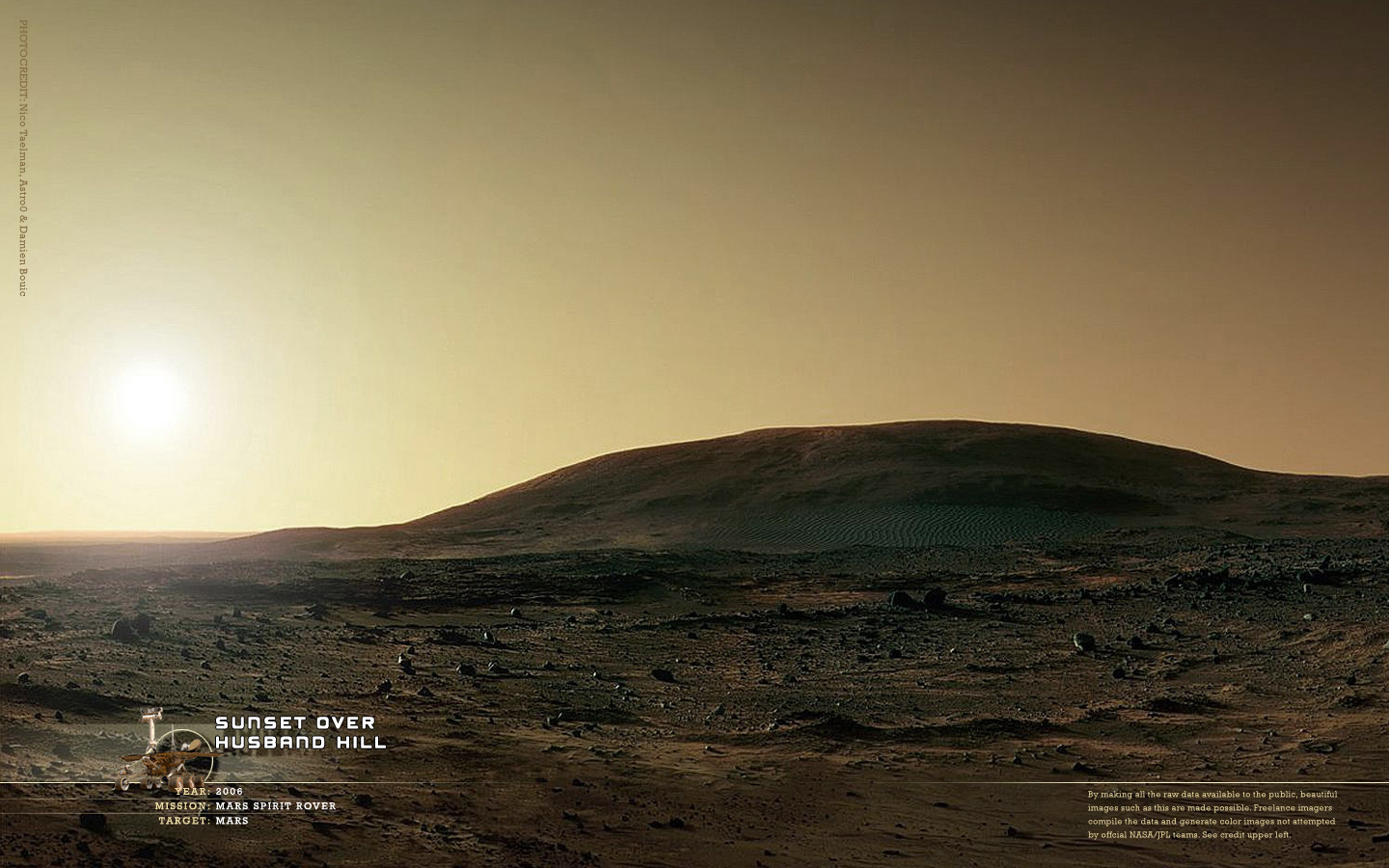 This is another fine example of freelance imagers at work. Many of whom spend time at unmannedspaceflight.com.
Titan Looking Earthly
Using an infrared camera, we see what Titan might look like if the atmosphere was at least partially clear. This is one of the more Earthly global images I have ever seen of Saturn’s biggest moon. Seeing as how this site’s focus on images is usually true-color and visible light, I rarely post anything on Titan’s surface which requires other means of seeing like radar or using alternate parts of the Electromagnetic Spectrum. This is unfortunate as Titan’s surface is one of the more fascinating places to consider when looking at our “local” cosmic neighborhood.

Saturnati
 Another gorgeous view of the ringed wonder joins the Saturnati. Dione Hangs above.
Io Erupts
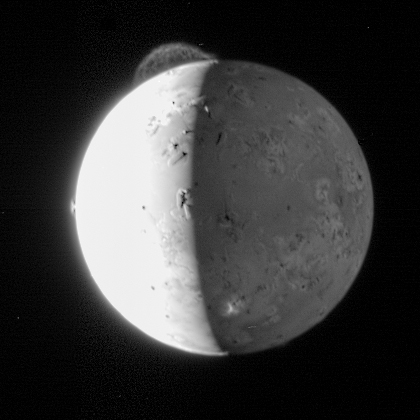
As New Horizons swung by Jupiter a few days ago, we got a good look at some new volcanic activity on Io. There are at least 3 active plumes seen in this image which is lit by both the Sun and Jupiter reflection (the New Horizon cameras were designed for the low light expected at Pluto). The largest one seen here, Tvashtar, represents the best detail we have ever aquired of an active volcano on Io… even compared to those of Galileo. The secondary plume at 9 0’clock is Prometheus and the third one, Masubi, is inset around 6 o’clock catching the light of the Sun on the dark side of Io.
This will be the last image of an early handful as the spacecraft is simply too busy recording data to turn around and face the Earth to talk to us. More images will be released in the coming weeks as activities die down and the spacecraft has less to record. Sadly, once the full stream of data is returned to Earth from this encounter – it will be the last up-close images we will see of Jupiter and its moons for at least 15 years as no new missions to Jupiter have yet been assigned. Based on previous experience, any new proposed missions to the outer Solar System will take at least 12 years to concieve, approve and build (especially depending upon its complexity). I only pray that I live to see the day that we go beneath the icy crust of Europa and take a fantastic other-worldly-under-sea voyage to a place that may be the only environment in our solar system hospitable to evolving life.
New Horizons Spies Ganymede and Europa


Active Plumes on Io
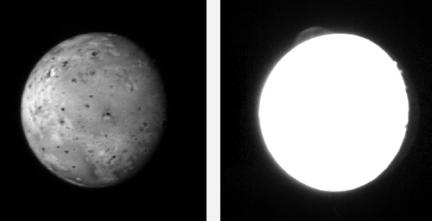 As New Horizons makes its closest approach to Jupiter, we are already seeing considerable activity from a volcano known as Tvashtar. This comes of no surprise as this was detected a few weeks back when scientists maintained observations of Io through the Hubble Space Telescope in preparation for this event. This is already the best image of an active volcano eruption on Io since the Voyager flybys in 1975 (revealed through over-exposure). Details here are somewhat greater than those taken by Galileo or Cassini and are expected to only get better before all the data is in.
Rosetta at Mars
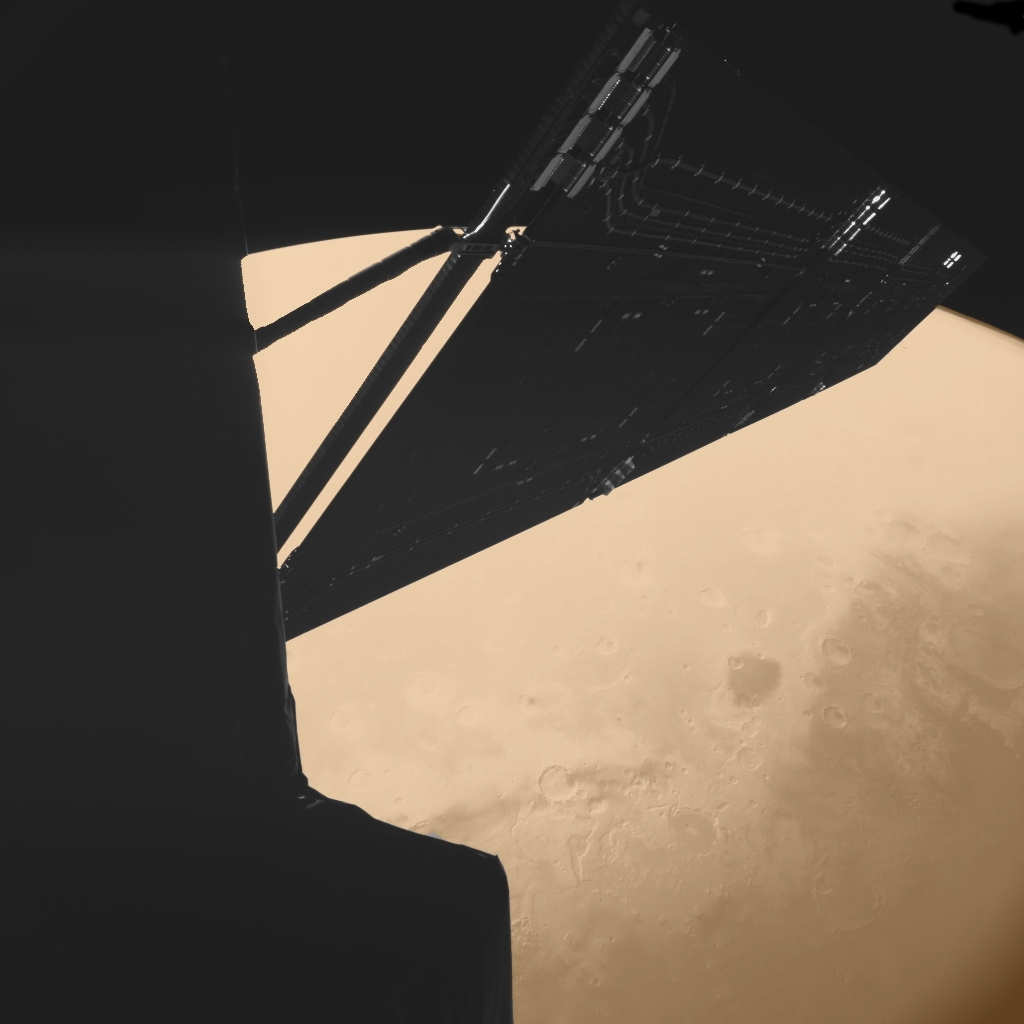
This gorgeous true color full globe of Mars may become the definitive Mars portrait image for the planet. For those may not have noticed, I have tried to apply a “portrait” label on at least one image per body as being the best representative full globe image of that world. The image I currently have tagged for Mars is that great image of Valles Marineris cutting across a near full disc of Mars taken by Viking.

Also worth posting is this semi-color image of Mars seen from behind the solar panels of the probe itself. It was taken by the lander attached to Rosetta which will one day detach itself from the parent probe and make an attempt to actually land on the surface of comet 67P/Churyumov-Gerasimenko in 2014. It looks as if it was originally a black and white image and someone at ESA just applied a color tone to the Mars globe, although I could be wrong.
Wallpaper: Europa Portrait Render
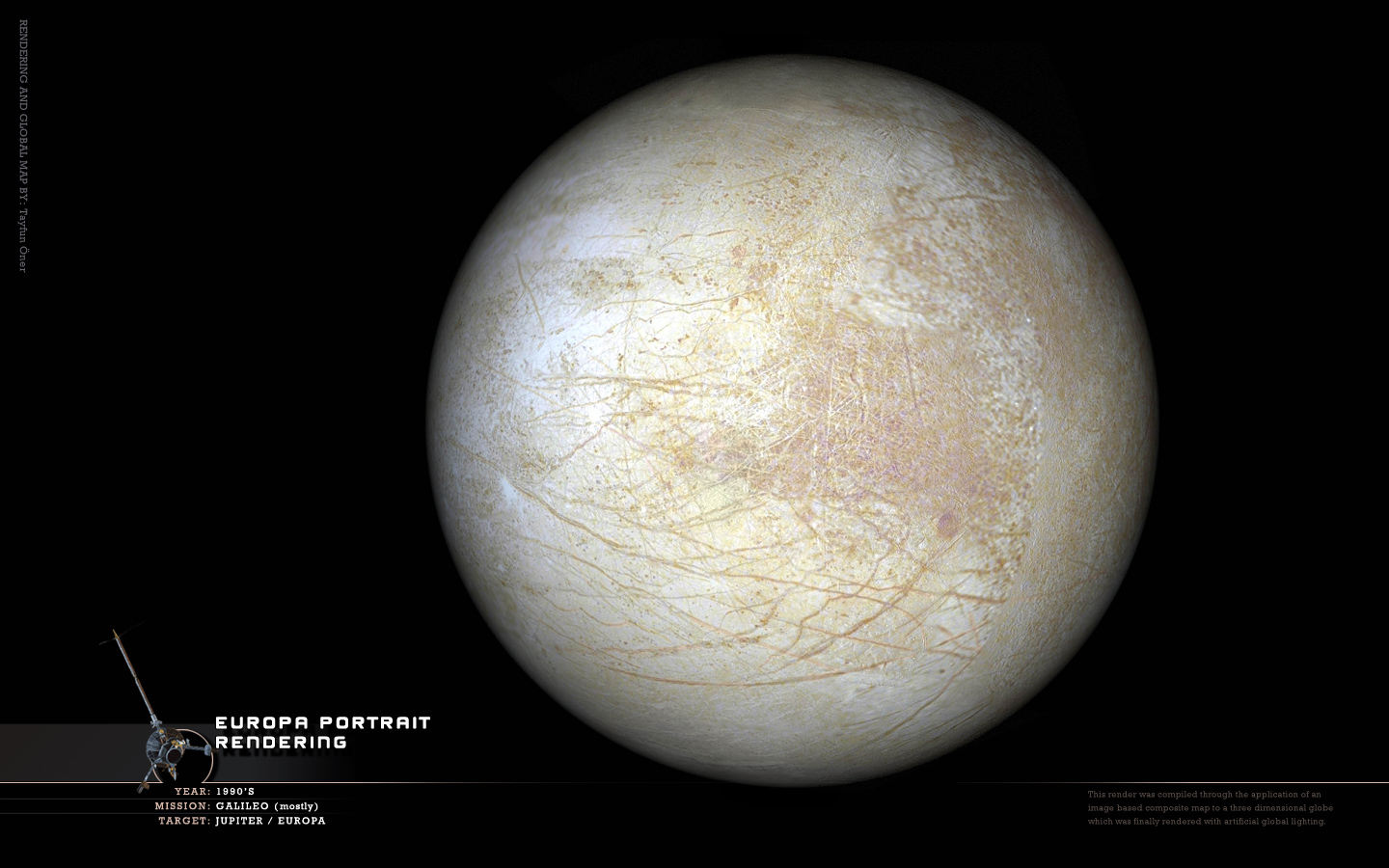 The previous Europa portrait posted here, is the most commonly seen image of the full globe of Europa. Even though there have been multiple missions to Jupiter and its system of moons (including an orbiter which stuck around for quite a while)… there are surprisingly few full globe images of Europa. The one used in the previous post mentioned was compiled through several filters but due to some incomplete data, an artificial green haze appears at the right edge of the disc. Considering the scientific importance of Europa and its unique appearance makes a full globe view of this world highly desirable in my mind.
Enter Tayfun Öner who is the author of the above render. This model was created by stitching together a map of the Europan surface from a multitude of images. At this point in history, a good amount of Europa has been photographed and allows one to make an almost complete surface map as seen below. The clearest and best resolved regions of the map are likely from the Galileo mission and where gaps appeared from that mission the spaces were filled in with images taken by Voyager. 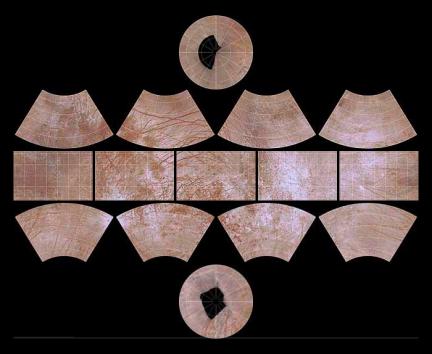 I usually prefer straight photography for the puposes of this site, but this is one of the most impressive renders I have ever seen of any body in the solar system. Seeing as how data sets for full global images of Europa are flawed at best… this render does the job most impressively. The full hi-res set of Europa maps by Tayfun can be found here for the curious.
2 Missions Swing by 2 Planets
The month of February is treating us to two gravity-assists and a chance to do some observations on the way to their primary objectives. On the 25th the ESA Rosetta probe, on its way to a comet Churyumov-Gerasimenko landing in 2014, will swing by Mars and momentarily join the gaggle of various probes currently studying Mars. Still a small disk in its view, this is how Mars looks to Rosetta set against the Milky Way.

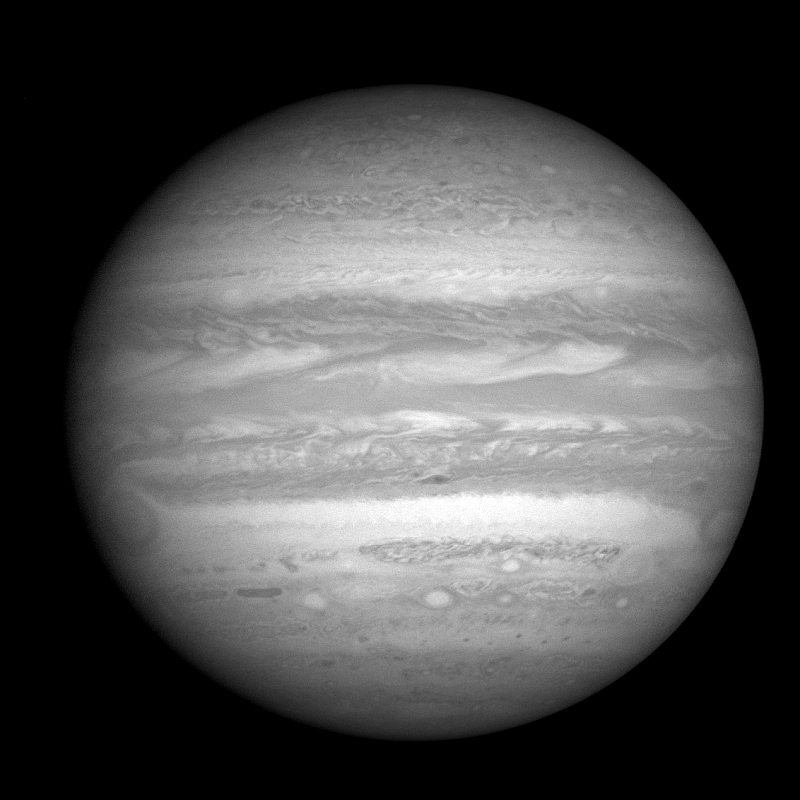
Then on the 28th, New Horizons on its way to Pluto will swing by Jupiter and conduct the first up close observations of the gas giant since the demise of Galileo. Jupiter at current already fills New Horizon’s full view.
First Image From Space
Contrary to popular belief, the first man-made object to enter space was not Sputnik. An amazing factoid considering that the space race was a major battleground in the Cold-War between the Soviets and America. Oddly, very little information about these first rockets into space can be found almost anywhere. One of the best references is this article from Air & Space magazine’s web site. The article is centers around the fact that, in addition to being one of the first man-made objects in space (the first was actually German!), the V2s also returned the first images of Earth from space. On October 24, 1946, a V2 rocket was blasted off from White Sands Missile Range and climbed about 65 miles straight up. There it began snapping images until minutes later it fell back to Earth with no parachutes. The cannister containing the camera was smashed, but luckily the film itself was unharmed and was later developed revealing to us Earthlings a glimpse of our own world from higher up than we had ever seen before.

While the above image is fascinating enough… that image was shot on V2 #13 and later experiments also took cameras along for the ride. Considering how long ago these were taken, another image from V2 #21 taken in 1947 is even more impressive in its detail and clarity.

Wallpaper: Looking Back at Earth
 Trying to get some decent Apollo images on here from time to time. So many of these images are so often seen that I want to focus on the ones that really are great but are rarely seen.
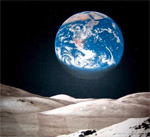 Seeing the size of Earth as it really appears from the surface of the moon reminds me of this wallpaper that I grew up with in my room as a child. I always assumed it was an actual image, but in reality the Earth appears about 1/20 the size and Earth would never phase in shadow from north to south under any circumstance! (I missed that obvious flaw as pointed out by Paul Neave). I beleive they still sell this wallpaper as I still see it around occasionally at stores and other public spaces (no pun). In addition to this image, you also see the Earth from moon shots taken while in- moon-orbit which also gives the Earth a far larger appearance… but I suspect that some good zoom lenses were likely utilized to get those looks as well.
Another Awesome Image from Ugarkovic
 I’m beginning to feel like this isn’t my blog anymore… I keep finding images processed by Gordan Ugarkovic to be among the very best out there. This is definitely the best color image I have seen of details in Saturn’s cloud tops. If you haven’t perused his flickr account, I’d avise you to do so. Go there to see the hires of this image and many others. It is a one-stop-shop for anyone longing to see more color from the Cassini mission http://www.flickr.com/photos/ugordan/
Wallpaper: Saturn Portrait II
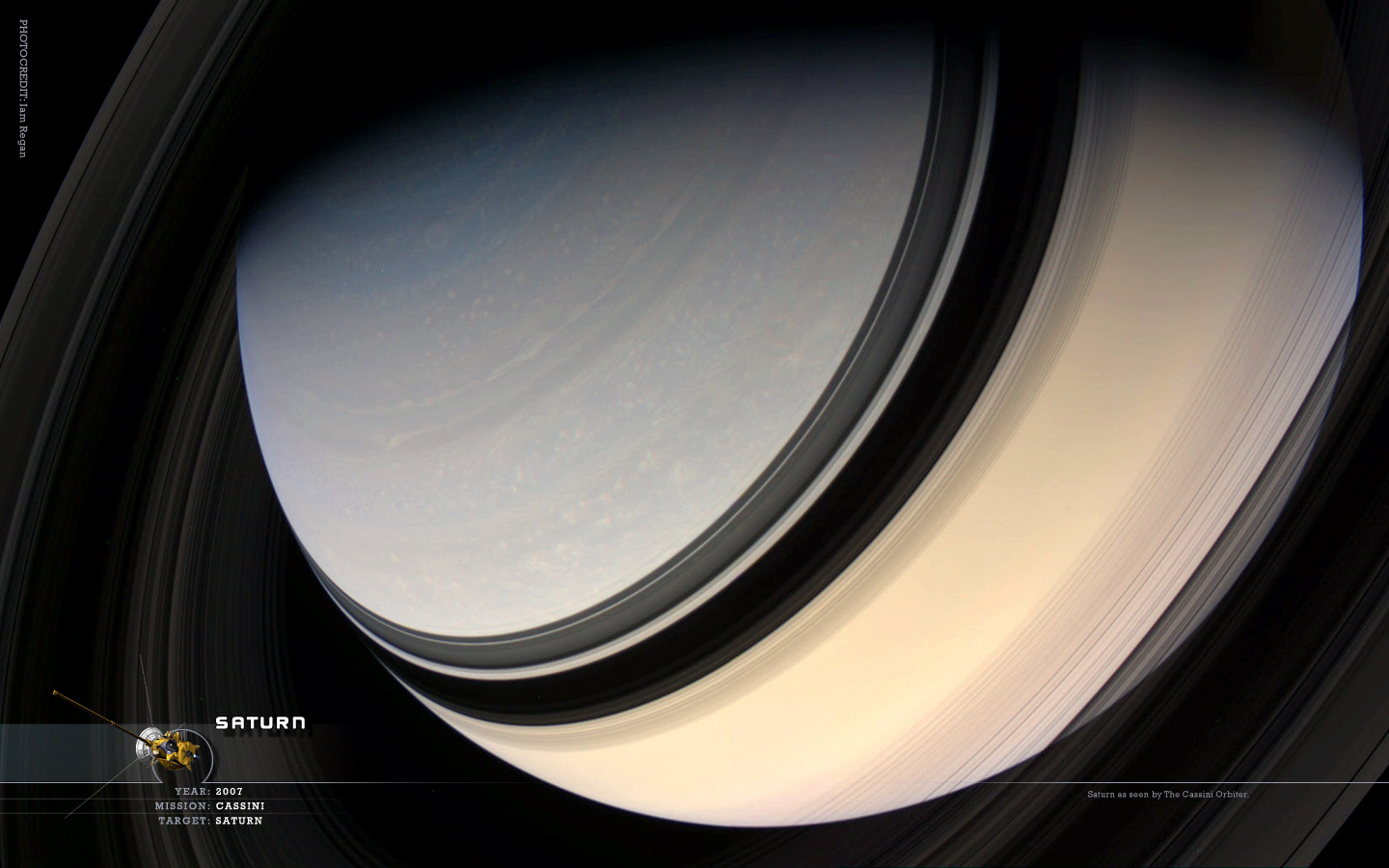 Not much to say about this one but, wow. This is better than the famous hi-res Saturn image from early in the Cassini mission. The composite image was made by Ian Regan who is a freelance imager.
Wallpaper: Rhea Portrait
 Rhea is the second largest of Saturn’s moons but lacks any of the exciting features of some of the others. It has some of the “wispy” features that have been determined to be ice cliffs on Dione, but they are far less prominent here. Just another big ball of water ice for future earth visitors to mine for resources!