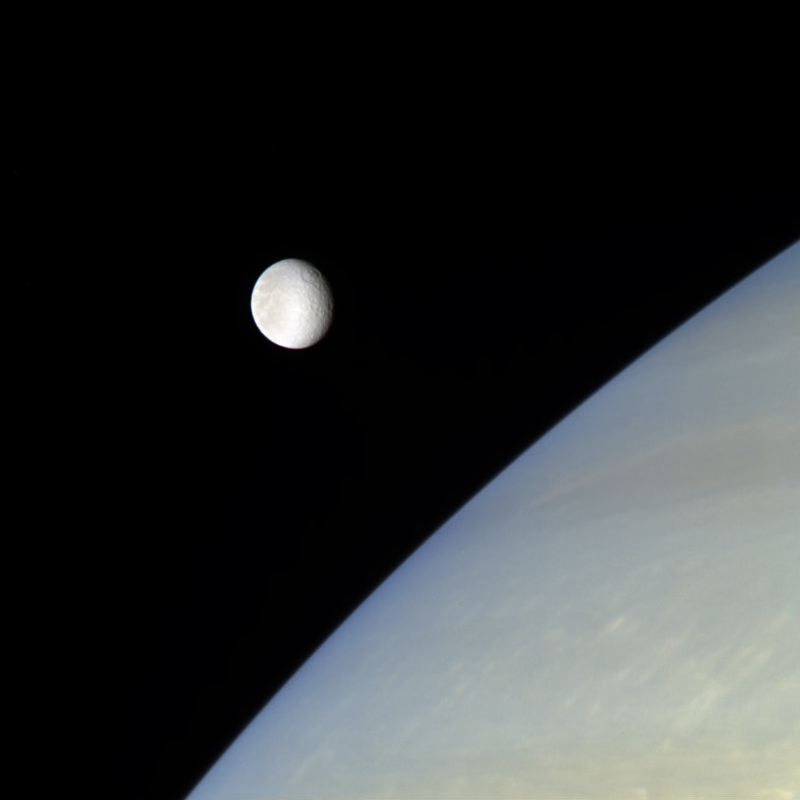
 Another Gordan Ugarkovic beauty.
Smallsteps Wallpaper: Surveyor 1
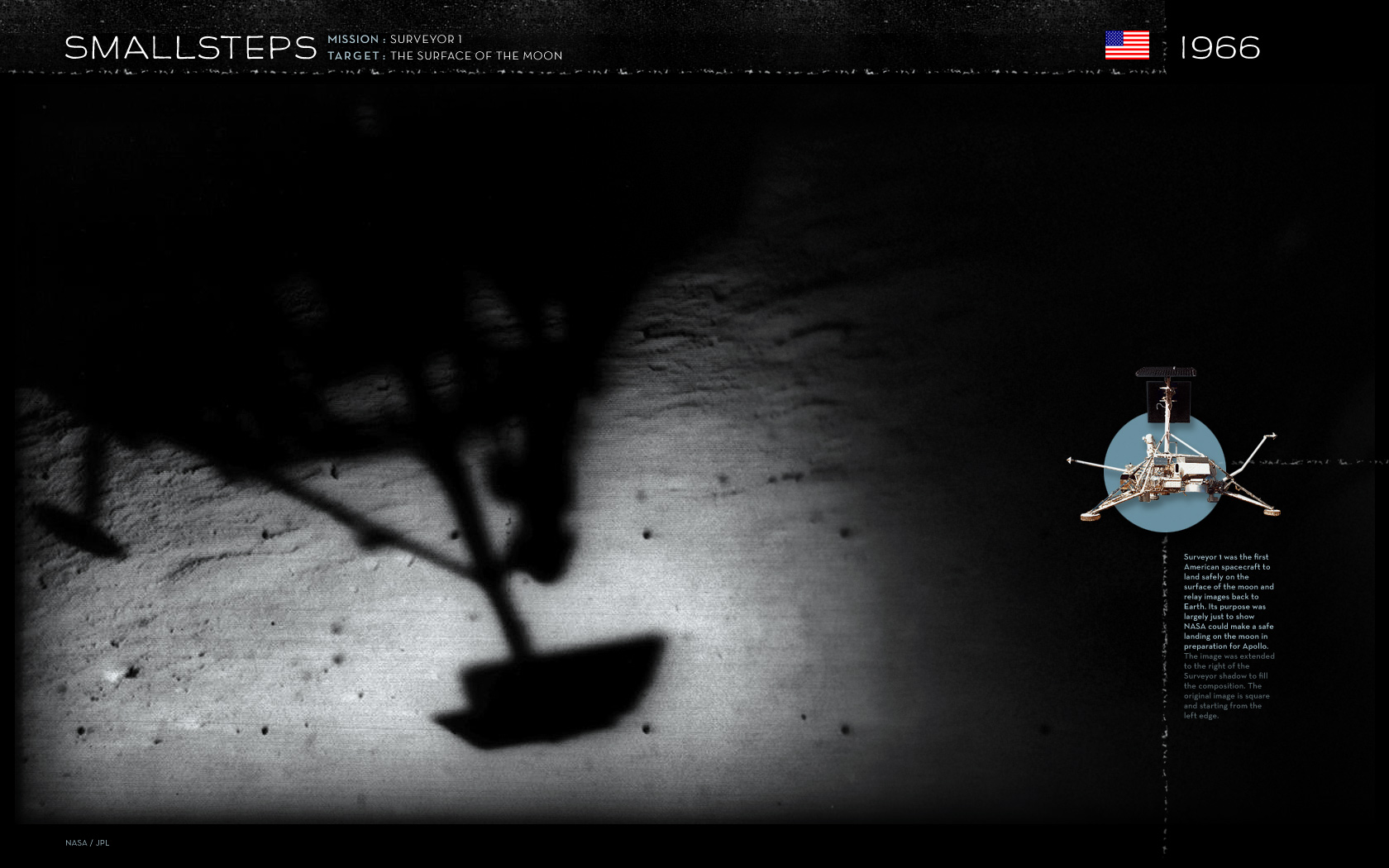 Look at the date on this mission. It’s 1966… 3 years before the Apollo 11 manned landing on the moon. It shows you what we as a species could really do had we the initiative to do it. Just 3 years after landing the first unmanned probe on the surface of the moon… we were ready to send people. That would almost be like sending men to Mars just a few years after Viking landed in 1976. Okay… it is much further away than the moon and many other technical difficulties as well. So lets say that it would been like sending people to Mars 10 years after Viking. That would be 1986 and here we are 20 years after that saying it will still take another 15.
The Surveyor craft was sent to the surface of the moon largely just to prove that we could do it. It was doing what its name suggested… surveying places for Apollo to plant a few flags.
2560 x 1600 Set 02 : The Moons of Jupiter
The moons of Jupiter (well, the 4 major ones) are in their own right, a Solar System within a Solar System. There is volcanically explosive Io; Europa with its cracks and ridges hinting at its huge internal ocean; Ganymede the largest moon in our celestial neighborhood and Callisto one the most heavily cratered bodies we have anywhere. The 4 moons are also called the Galilean moons as they were discovered by Galileo and have since been revealed to be more fascinating than most planets are. The images below represent what I think are likely the best representative images of these places that can fill a 2560x1600 screen. At this size, the details are quite impressive… do take a look even if you can’t make use of the images as wallpaper images.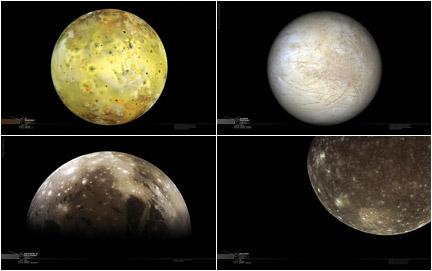
The Europa image is actually a render created by Tayfun Öner as not that many satisfactory images exist of a full globe Europa. Many great images exist of Ganymede but most are low resolutions, this image was stitched together by Ted Stryk of www.unmannedspaceflight.com. The other two are officially released NASA composites.
In the Shadow of the Moon Trailer
 The Ron Howard documentary “In the Shadow of the Moon”, came to theaters on September 7th. How did I miss this? See the trailer here.
Wallpaper: Iapetus Bright Portrait
 It had to happen… regularly featured on this site Gordan Ugarkovic stitches together an awesome hi-res full globe image of Iapetus only a few days after the closest approach (see previous post for even larger sized wallpaper for bigger monitors). I usually only label an image a “portrait” once for each body, but seeing as Iapetus has two different sides… I think it deserves two. Here is the darker side imaged earlier in 2005.
2560 x 1600 Set 01
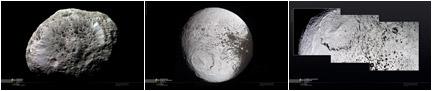
Images large enough to fill a wallpaper this large are few, but there are some. Here is set 01 which includes two images of Iapetus from this week’s encounter and one of Hyperion.
Iapetus September 12 (color)
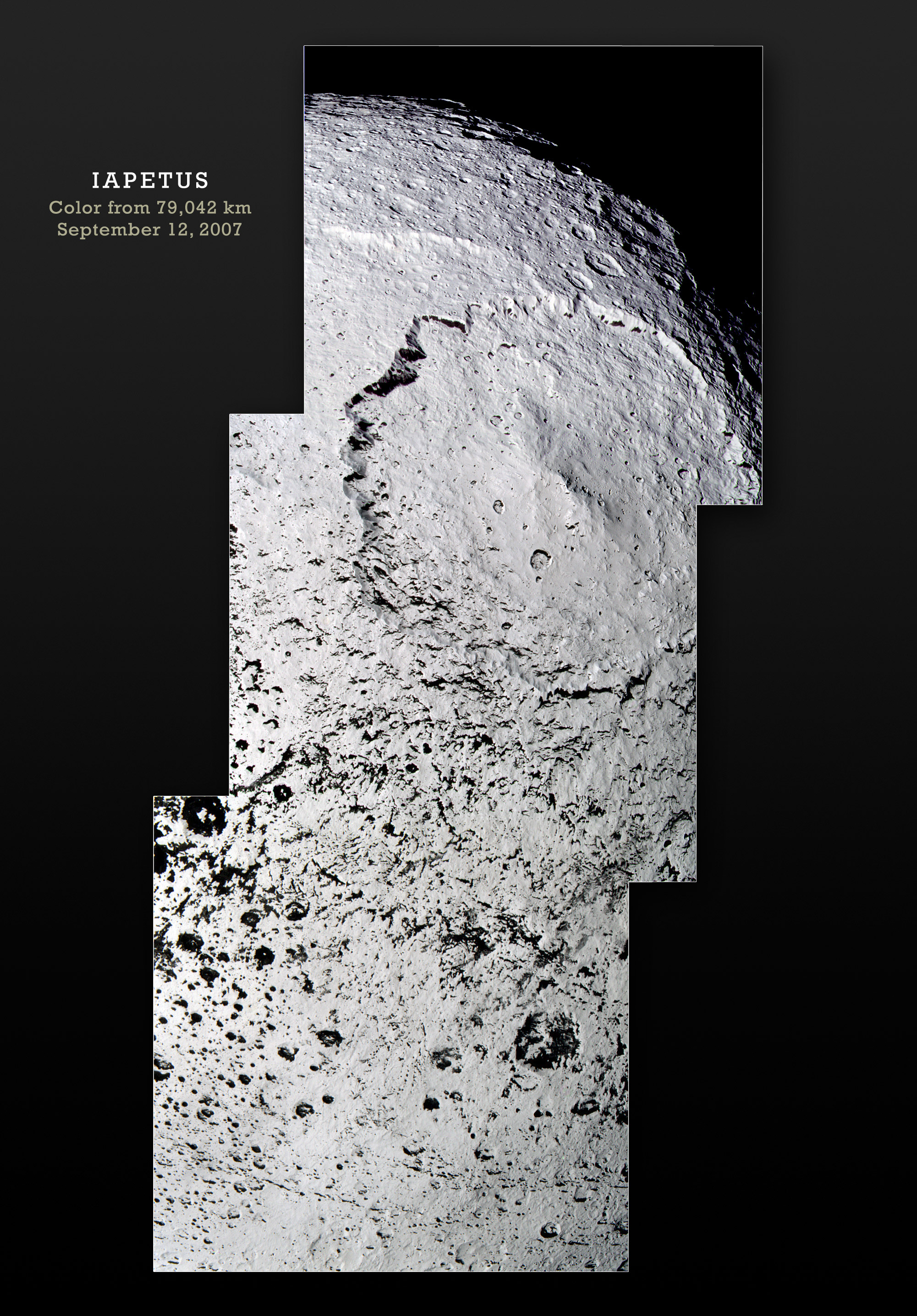 In the world of moons and planets people are quite excited about the recent Cassini flyby of Iapetus. What we have known about this moon for quite some time is that it is much lighter on one side than the other. Voyager gave us a peek at that phenomenon and then when Cassini got a closer look it started to seem as if something has rained down this dark material on one side of the moon but not on the other. However, now that Cassini has come within 1500 km the details are staggering. Nobody has any idea at this point what possible process could have created this surface. There are places where the bright material seems deposited and others where the dark does.
As more details and theories come in, there will be additional posts. Just worth noting that the scientific community seems to be as excited about this as they were when they got their first looks at Jupiter’s moons from Voyager.
By the way, DO CLICK ON THAT IMAGE above… its HUGE.
Iapetus September 10 - The Ridge (mono)
The ridge at Iapetus’s equator from only 3,148 km. The black and white nature of Iapetus is only one of its bizzare traits, the other is the huge mountain range that runs almost completely around its equator. This the feature that often causes the mainstream media to compare the moon to a walnut.

That feature is clearly seen in this previous post.
Iapetus September 10 - 03 (mono)
 Wow. Just totally unreal.
Iapetus September 10 - 02 (color)
 The regions including the stark boundaries between the mysterious dark and bright sides of Iapetus are coming in. This bit looks to be like just a part of what would seem to be the potential to assemble a huge hi-res color image of the moon’s full disk.
Iapetus September 10 - 01 (color)
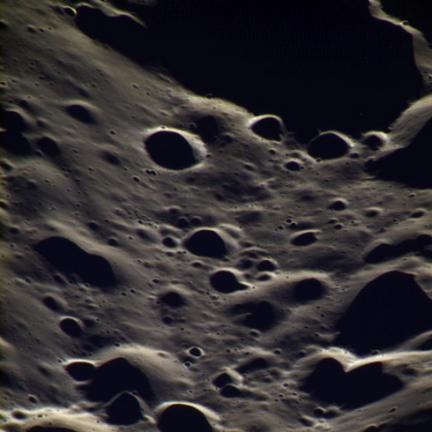 From yesterday’s encounter at 8,593 kilometers. Near true color image constructed from the infrared, green and ultraviolet filters.
Iapetus From 1,478 km (mono)
Found a few more to make this b&w composite, but no ridge or border between the high and low contrast regions seen here. I would guess that the closer and full disc images would be coming in the next transmission which I read is probably in a few hours from now.

Iapetus Images Coming In
 Images are starting to appear on the Cassini raw files site. Click the above image to get the giant color hi-res composite by Emily Lackdawalla from The Planetary Society website. The famous walnut ridge is clearly visible in better detail than we have seen previously. Also visible is a clear boundary between the famous Iapetus white and dark sides beginning to appear on the right.
Smallsteps Wallpaper: Luna 9
 The very first time we humans ever had a look at the surface of another world was in 1966 with the Luna 9 spacecraft. The event is nearly wiped from our collective memory after the successes of Apollo, but at the time this was another feather in the cap of the Soviet Space Program. Now they were able to claim the first successful touchdown as well as first man in space, first spacewalk, first object in space… you name it.
Smallsteps Wallpaper: Luna 21 & Lunokhod 2
 The Lunokhod 2 rover lasted much longer and traveled much further than Lunokhod 1 did. It covered a distance of 37 km and operated for 4 months.
Smallsteps Wallpaper: Luna 17 & Lunokhod 1
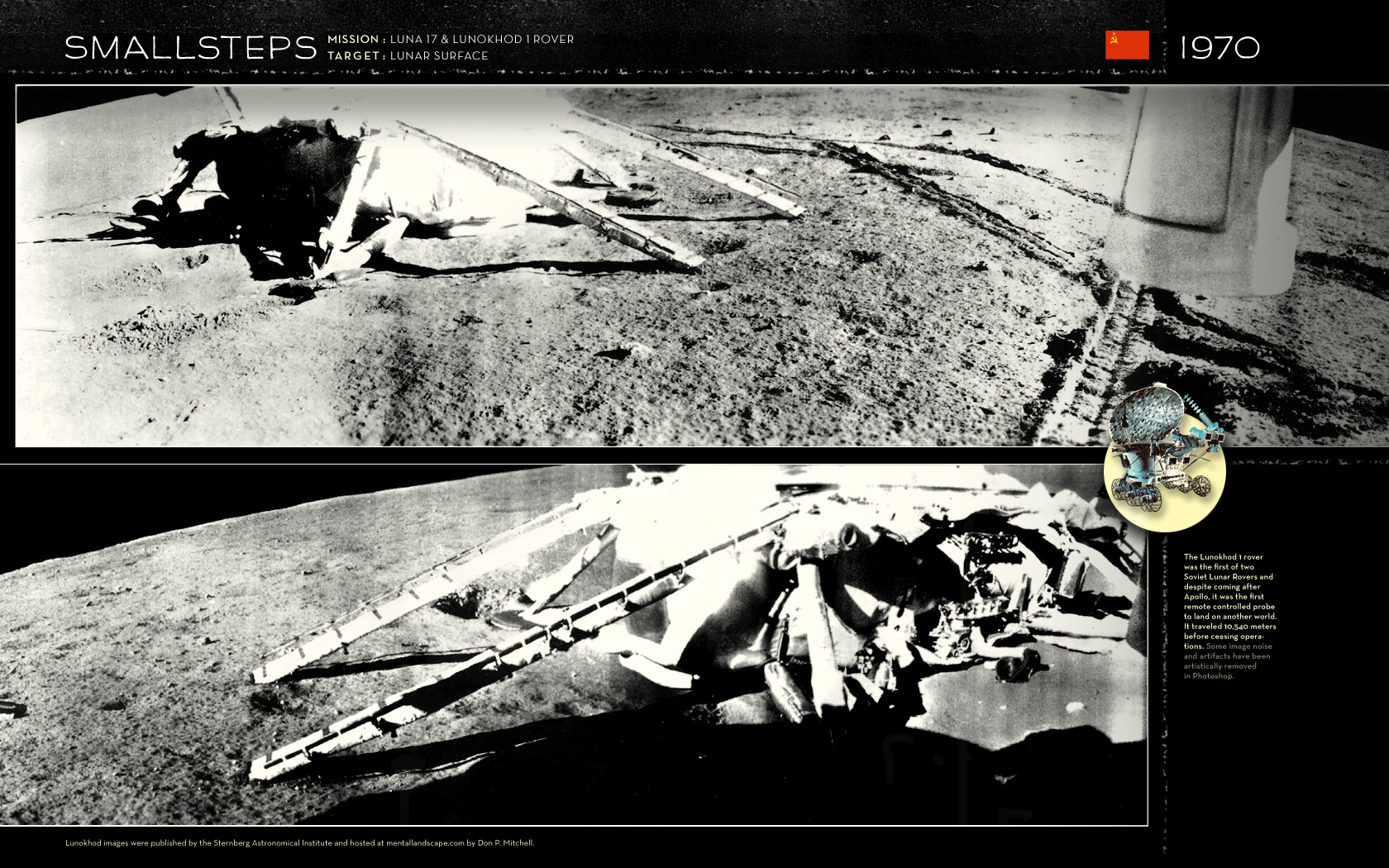 More than a year after Americans set foot on the moon in 1969, the Soviets landed the worlds first remote “rover” type vehicle ever to explore the surface of another world. One almost has to wonder how the politics of this mission even played out to bother even letting it continue. It would hardly seem worthwhile sending a robot to do the work actual humans would be conducting 5 more additional times beyond the historic Apollo 11 landing from the year previous.
The rover was named “Lunokhod” and translated means, “Moon Walker”, it carried out a mission for 11 days and traveled 10.5 km. Despite the fact that nobody knows exactly where the rover rests today, the rover and lander were sold at auction in 1993 for $68,500. The auction catalog read that it was, “resting on the surface of the moon”.
Smallsteps Wallpaper: Luna 3
The Soviet spacecraft Luna 3 was the third such craft to be successfully sent to the moon in history. The images were not very great, as can be seen… but it was the first glimpse mankind ever had of the side of the moon that is permanently facing away from us. With the first look at the “dark side of the moon” many people were quite excited and the images were published the world over. It took a total of 29 pictures and was able to image at least 70% of that unseen side of the moon.

The image is largely intact but for the purposes of presentation I faked the “8” in the number on the bottom and actually added some noise lines.
Smallsteps Wallpaper: V2 Rocket
While looking at all the strange images from old Soviet moon missions on Don Mitchell’s site, I thought it would be interesting to design a set of wallpapers from these early images. I call the series “Smallsteps” as in Neil Armstrong’s famous, “One small step…” quote from Apollo 11. Obviously, there would have been no “giant leap” without a large number of these other “small steps” preceding the Apollo Program (although some of the images I have planned actually come after or during the Apollo program).

To me, the fact that the human race was even doing space exploration back then seems almost out of time — and then you look at the spacecraft that were sending back these images and it is amazing that anything really ever worked. Tin cans with cameras sending back images that were often just as bizzare and rough as the vessels that carried them. It is even more incredible when you consider that people eventually started strapping themselves to these rockets and floated around the vacuum of space in boxes wrapped with foil.
Seems appropriate enough to start the whole set off with the V2 images of Earth sent back in the shockingly early year of 1948. According the the Air and Space Museum these are the first images of the Earth taken from space in history. The image itself I suspect was just scanned from some print and the number tags and directionals are original (although there were about 17 of them and I removed a majority of them in Photoshop).
Closest Iapetus Flyby of Mission In 2 Days
 On Sept. 10, the Cassini spacecraft performs its closest flyby during the entire mission of the odd moon Iapetus, passing by about 1,640 kilometers. The moon is somewhat further out than most of the others, so despite the fact that Cassini has many months if not years in front of it still, the moon is too out-of-the-way to be making any additional passes. Who knows when another spacecraft will be this close again? Hope its a good look… it will have to last.
I made this “close to true color” image from the raw files using the BLU, IR1 and GRE filters. The distance seen here is approximately 694,000 kilometers.
Big Red Marble
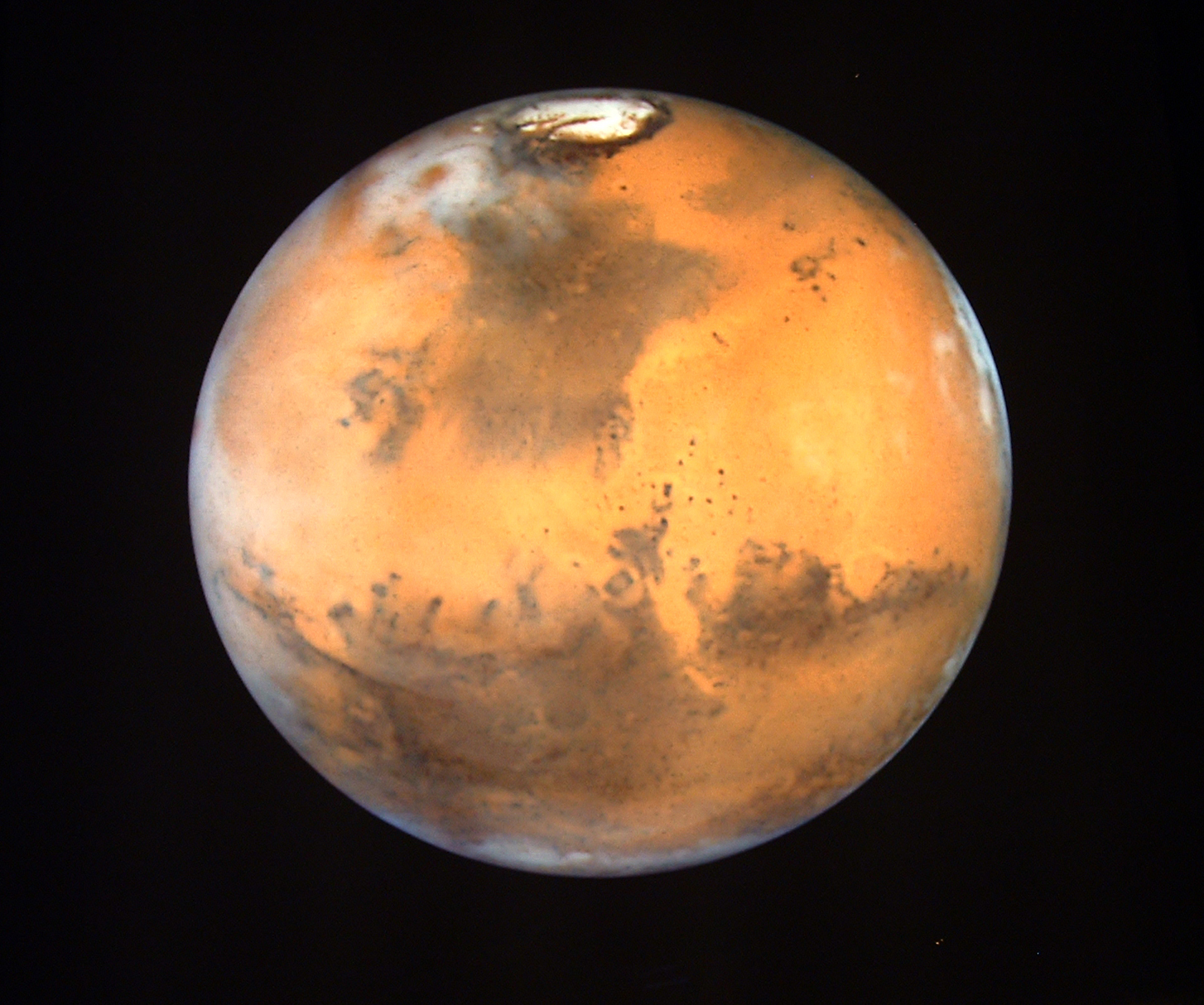 Just thought this was a pretty view of Mars taken by Hubble. It seems “shiny” like a marble. The orignal was found at this Flickr account.